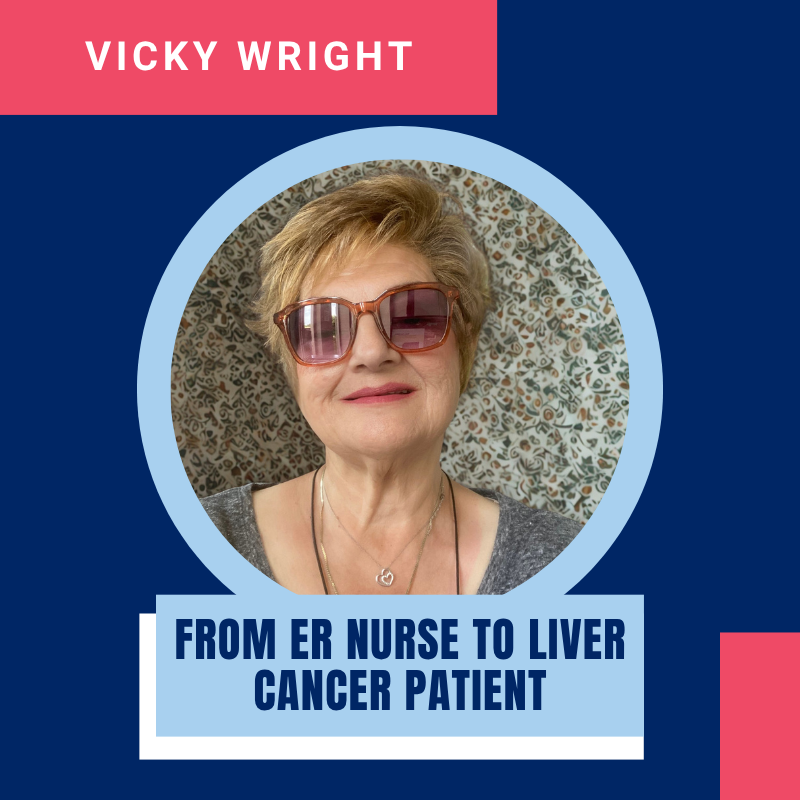
Liver Cancer Changed Vicky Wright's Life Overnight
When advocate Vicky Wright went to work one night in March 2019, she expected a normal shift in the emergency room trauma center where she worked full-time. Instead, she became the patient.
Vicky felt tired, nauseous, and unusually weak before her overnight shift. At first, she thought the feeling would pass once work became busy. It did not.
As the night continued, her coworkers noticed something was wrong.
"You don't look good," several ER doctors told her.
By the next morning, Vicky checked into the emergency room herself. After scans and testing, doctors diagnosed her with hepatocellular carcinoma (HCC), the most common type of primary liver cancer.
The diagnosis shocked her.
"It was disbelief," Vicky said. "What do we do now?"
A Healthy Life With No Warning Signs
Before liver cancer entered her life, Vicky described her world as stable and fulfilling.
She worked in emergency medicine, spent time with family and friends, and planned to continue working until she was around 70. She enjoyed staying active and living a normal routine.
Even while working in healthcare, Vicky had never heard of HCC before her diagnosis.
Her symptoms also seemed vague at first. She did not experience dramatic pain or obvious warning signs. Instead, she felt exhausted, nauseous, and unlike herself.
That subtle beginning reflects a difficult reality for many people with liver cancer. Symptoms often remain hidden until the disease reaches an advanced stage.
A Race Against Time
Doctors quickly learned that Vicky's original tumor was too large to remove surgically.
Still, her medical team moved fast.
One oncologist immediately contacted specialists at a teaching hospital to explore treatment options. Vicky remembers how quickly everything happened after that phone call.
"It was kind of like being in the right place at the right time," she said.
Doctors referred her to interventional radiology, where she began a long series of targeted liver cancer treatments designed to shrink or destroy the tumors.
Her treatment journey included:
TACE procedures, which deliver chemotherapy beads directly into liver tumors
Microwave ablation procedures to destroy tumors by cutting off their blood supply
Y90 radioembolization treatment, which uses radioactive particles to target cancer cells
Each procedure brought hope. Each follow-up scan brought uncertainty.
Doctors repeatedly found new tumors.
At one point, Vicky's hepatologist worried she might never qualify for a transplant.
Still, Vicky pushed forward.
When doctors mentioned Y90 as a final option, she wanted to try it.
"We haven't tried this," she told them.
That decision helped change everything.
Finally Qualifying for a Liver Transplant
After her treatments successfully controlled the cancer, Vicky finally reached an important milestone. She remained tumor-free long enough to begin transplant evaluation.
Eventually, she qualified for a liver transplant.
Emotionally, the journey had been exhausting. But Vicky relied heavily on her faith to stay grounded.
"The Lord knows when our expiration date is," she said.
She also refused to let cancer define her identity.
"I didn't want my cancer to define who I was and what I did."
Then came the phone call every transplant patient hopes to receive.
Actually, Vicky received two calls.
The first liver offered to her carried serious medical risks tied to the donor's history. After discussing the situation with her daughter, Nicole, and the transplant surgeon, Vicky made the difficult decision to decline it.
About six to eight months later, another call came.
This time, doctors had found a strong donor match.
On April 20, 2023, Vicky received her liver transplant.
Learning to Live Again
The transplant brought relief, gratitude, and a chance to reclaim normal life.
Vicky remembers the experience feeling almost unreal.
"It's almost too good to be true," she said. "I can't believe that this happened, and I've been blessed with this gift.”
After recovering from major surgery, she slowly returned to everyday life.
For a while, things looked hopeful.
Then another devastating setback arrived.
When Liver Cancer Returned
In March 2024, less than a year after her transplant, doctors discovered metastatic HCC in Vicky’s lungs.
The news crushed her.
“You’re reassured so strongly that there’s a very small percent that there’s recurrence,” she explained.
A bronchoscopy and biopsy confirmed the diagnosis.
Even after facing recurrence, Vicky continues approaching life the same way she approached every stage of treatment.
She focuses on moving forward."Nothing's going to change it," she said. "So, we have to move forward and see what there is to do."
The Power of Support
Throughout her journey, Vicky leaned heavily on the people around her.
Her husband, daughter, sister, extended family, coworkers, and longtime friends all became part of her support system.
She knows not everyone has that type of network. That is why she encourages others facing liver cancer to seek support wherever they can find it.
For some people, that may mean turning to organizations like or joining a support group.
“Try to reach out," Vicky said.
Her story reflects both the uncertainty and resilience that many liver cancer patients experience. Even after years of treatments, setbacks, and recurrence, Vicky continues choosing hope, faith, and connection over fear.
And at every stage of the journey, she continues to move forward.